India’s Influence in Asia

India’s influence in Asia is civilisational, cultural, spiritual, and intellectual, stretching back thousands of years. Long before the rise of modern nation-states, the Indian subcontinent served as a major centre of trade, philosophy, science, and spirituality that shaped large parts of Asia through exchange rather than conquest. Unlike empires that expanded primarily through military force, India’s influence travelled through merchants, monks, scholars, and sailors who carried ideas, art, language, and belief systems across land and sea routes. 

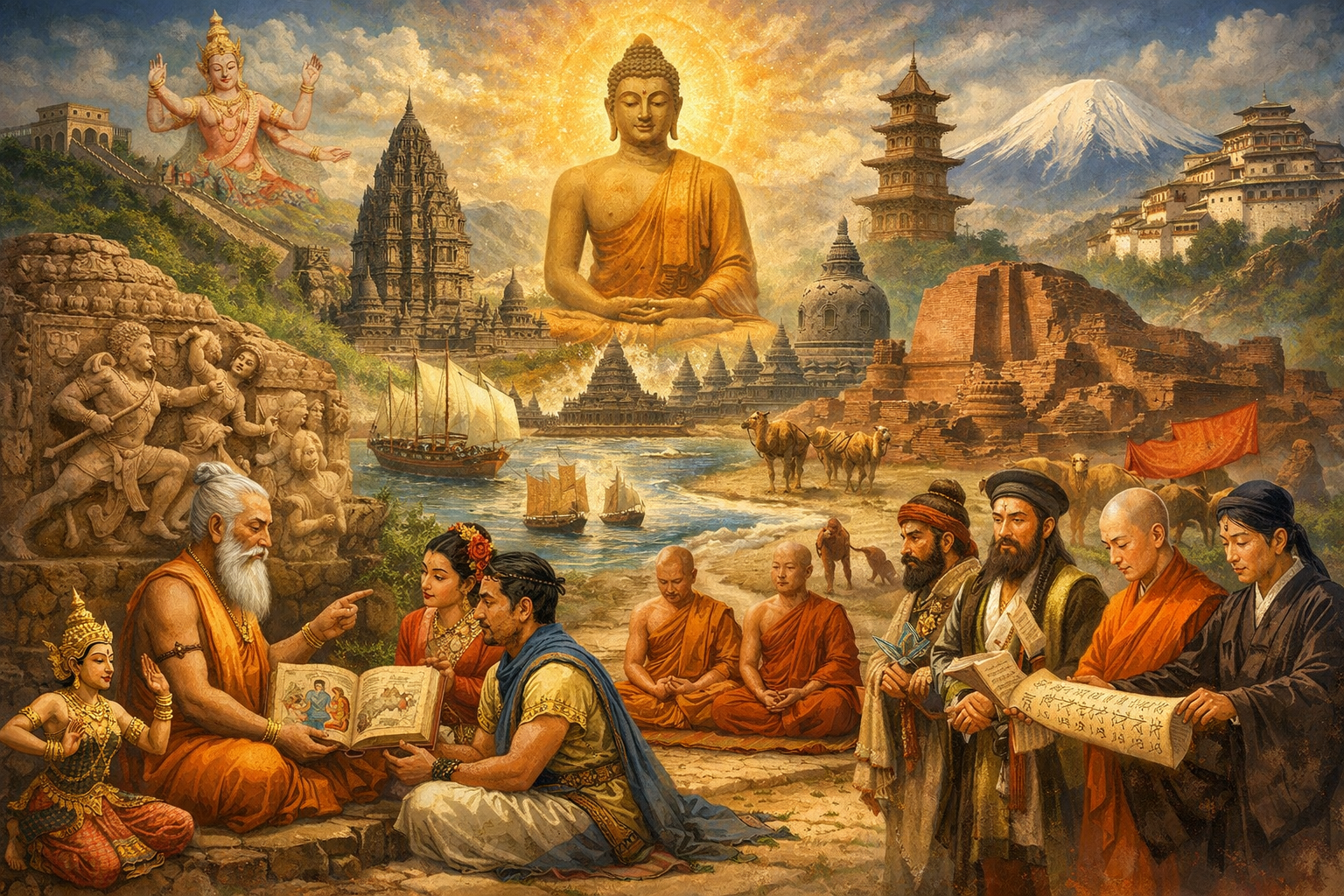
One of the most profound aspects of India’s influence was spiritual. Hindu and Buddhist philosophies spread widely across Southeast Asia, East Asia, and Central Asia. From Cambodia and Indonesia to Thailand and Vietnam, Indian epics such as the Ramayana and Mahabharata became embedded in local cultures, adapted into regional languages, dance traditions, theatre, and folklore. The temples of Angkor Wat in Cambodia and Prambanan in Indonesia reflect strong Indic architectural and mythological influence, demonstrating how Indian cosmology and sacred symbolism were embraced and reinterpreted in distant lands. 

Buddhism, which originated in India, became one of Asia’s most transformative spiritual traditions. Indian monks travelled along the Silk Route and maritime trade networks, bringing teachings that would shape China, Korea, Japan, Sri Lanka, Myanmar, Thailand, and Tibet. Universities such as Nalanda attracted international scholars, and translated Sanskrit texts formed the foundation of East Asian Buddhist philosophy. Through Buddhism, Indian ethical concepts such as compassion, non-violence, and the pursuit of enlightenment became central to Asian civilisations. 
India also influenced Asia through language and knowledge systems. Sanskrit functioned as a classical language of scholarship and governance in many Southeast Asian courts. Indian scripts inspired writing systems across the region. In the fields of mathematics and astronomy, Indian innovations such as the concept of zero and the decimal system travelled westward and eastward, profoundly influencing scientific development. Ayurvedic principles and traditional medical knowledge also found resonance beyond India’s borders. 

Trade played a crucial role in spreading Indian influence. Ancient Indian merchants established maritime networks across the Indian Ocean, linking the subcontinent with Southeast Asia, Arabia, and beyond. These exchanges were not limited to goods like spices, textiles, and precious stones; they carried cultural practices, artistic motifs, and administrative models. Indianised kingdoms in Southeast Asia adopted elements of Indian political theory, court rituals, and temple-building traditions while maintaining their own distinct identities. 

In modern times, India continues to shape Asia through diplomacy, economics, and soft power. As one of the world’s largest democracies and fastest-growing major economies, India plays a strategic role in regional stability. Its cultural exports — from yoga and Ayurveda to cinema and cuisine — maintain deep popularity across Asian societies. Indian diaspora communities across Southeast Asia and the Gulf region further strengthen economic and cultural ties. 

India’s influence in Asia is unique because it was largely transmitted through dialogue, adaptation, and mutual exchange rather than domination. Asian cultures did not become replicas of India; instead, they absorbed and transformed Indian ideas into their own distinct civilisational identities. This organic cultural flow created a shared heritage that still connects large parts of Asia today. 

Ultimately, India’s legacy in Asia is not merely historical but ongoing. It represents a tradition of intellectual openness, spiritual exploration, artistic richness, and intercultural exchange that continues to shape the continent’s evolving story.Â