

Mathematics
India has made profound contributions to the field of mathematics, shaping the foundations of modern numerical systems. Ancient Indian scholars introduced the concept of zero, the decimal system, and advanced arithmetic techniques that revolutionised global mathematics. Mathematicians such as Aryabhata, Brahmagupta, and Bhaskara made pioneering discoveries in algebra, geometry, trigonometry, and astronomy, long before similar developments appeared in other parts of the world.
Mathematics in Indian civilisation was not limited to abstract theory but was deeply connected to daily life, architecture, astronomy, and philosophy. From temple construction and calendar calculations to navigation and trade, mathematical knowledge played a crucial role. India’s mathematical heritage continues to inspire modern science and education, standing as a testament to the intellectual depth of ancient Indian culture.
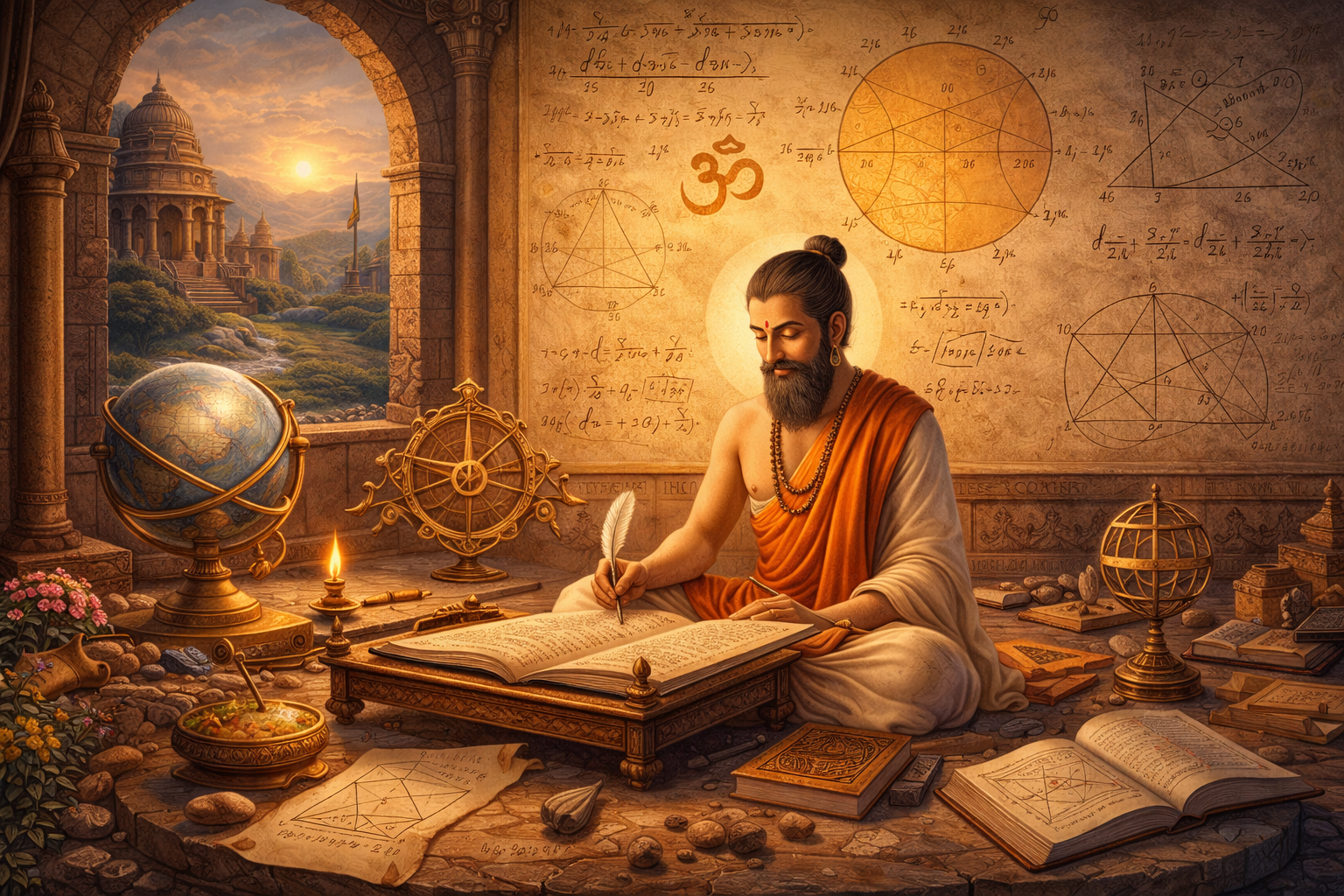
The Glorious Heritage of Indian Mathematics: A Timeless Intellectual Revolution
Indian mathematics stands as one of the most profound and influential intellectual traditions in human history, shaping not only the scientific development of the Indian subcontinent but also leaving a lasting imprint on global knowledge systems. From the earliest phases of civilisation to the medieval period, Indian thinkers explored numbers, patterns, geometry, algebra, and astronomy with extraordinary depth and creativity. What distinguishes Indian mathematics is not merely its antiquity, but its continuity, originality, and its remarkable ability to blend abstract reasoning with practical application. The journey of Indian mathematics is, therefore, not just a story of numbers, but a story of human curiosity, philosophical insight, and scientific brilliance.
The origins of mathematical thought in India can be traced back to the Indus Valley Civilization, which flourished around 2500 BCE. Archaeological discoveries from cities such as Mohenjo-daro and Harappa reveal a highly sophisticated urban culture that depended heavily on mathematical precision. The use of standardized weights and measures indicates a clear understanding of numerical systems and proportionality. The grid-like patterns of city planning, with carefully aligned streets and drainage systems, demonstrate an advanced grasp of geometry. Although written mathematical texts from this period have not survived, the material evidence strongly suggests that mathematical knowledge was already deeply embedded in daily life and governance.
As Indian civilisation progressed into the Vedic period, mathematical ideas began to take more explicit form within religious and philosophical texts such as the Vedas. These texts, composed between 1500 and 500 BCE, contain references to large numbers, sequences, and basic arithmetic operations. The fascination with numbers was not merely practical but also symbolic and philosophical, as numbers were often associated with cosmic principles and metaphysical ideas. This blending of spirituality and mathematics became a defining feature of Indian intellectual culture, where the pursuit of knowledge was seen as a path to understanding the universe itself.
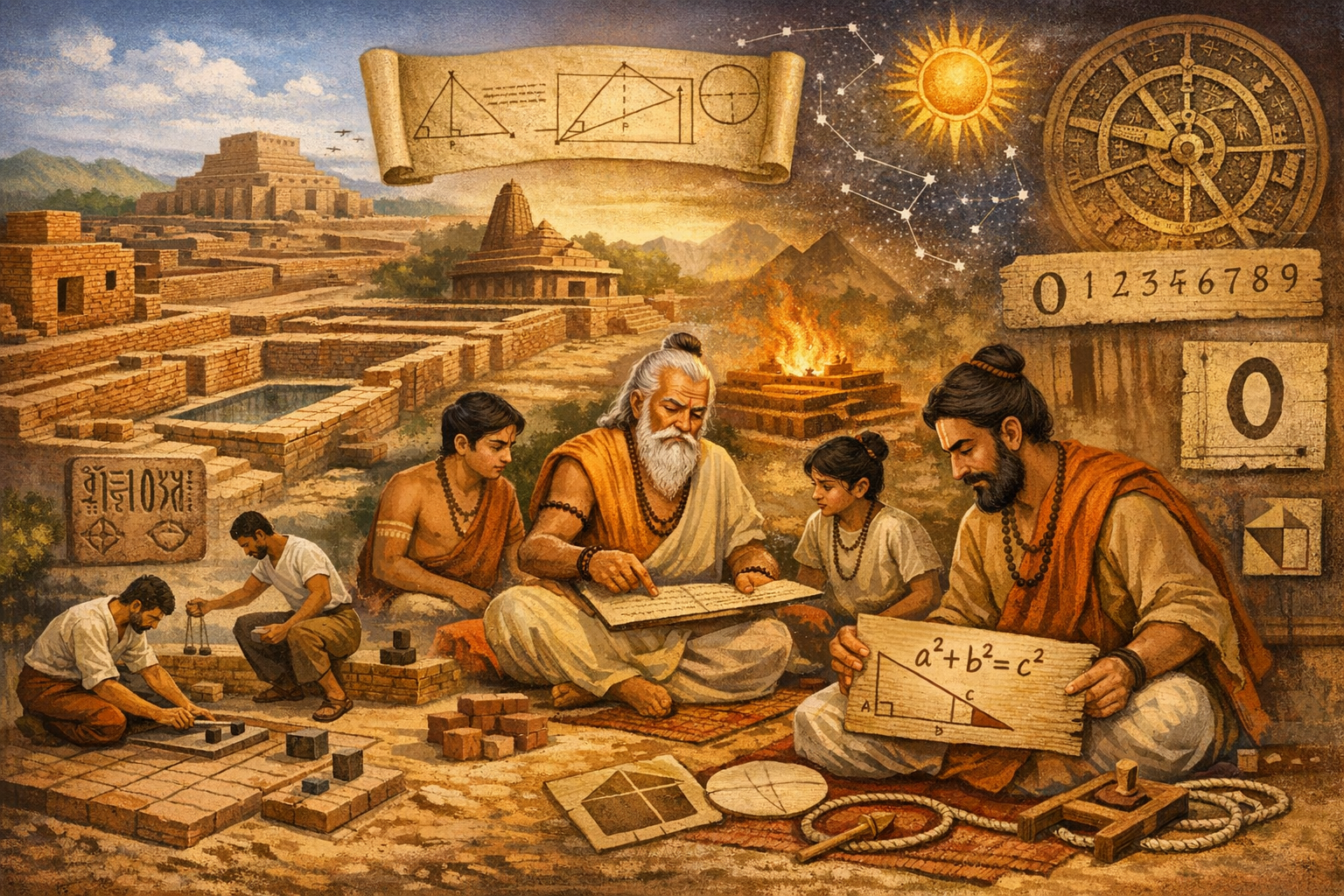
One of the earliest systematic developments in Indian mathematics is found in the Sulba Sutras, composed between 800 and 500 BCE. These texts were designed to provide instructions for constructing fire altars used in Vedic rituals, but in doing so, they introduced sophisticated geometric principles. The Sulba Sutras contain what is essentially an early version of the Pythagorean theorem, demonstrating that Indian mathematicians understood the relationship between the sides of a right-angled triangle long before it became widely known elsewhere. They also describe methods for constructing geometric shapes such as squares, rectangles, and circles with remarkable precision. Techniques for approximating irrational numbers and
transforming one geometric shape into another reveal a deep and practical understanding of geometry, rooted in both ritualistic and scientific needs.
Perhaps the most revolutionary contribution of Indian mathematics to the world is the invention of zero and the development of the decimal place value system. This innovation fundamentally transformed mathematics by introducing a simple yet powerful way to represent numbers and perform calculations. The concept of zero as both a placeholder and a number in its own right was first clearly articulated by the महान mathematician Brahmagupta in the 7th century CE. In his work, he defined rules for arithmetic operations involving zero and negative numbers, laying the foundation for modern algebra. The decimal system, which allows numbers to be expressed efficiently using ten digits, originated in India and later spread to the Islamic world and Europe, where it became the basis of global mathematical practice. Without this invention, the development of science, engineering, and commerce as we know them today would have been unimaginable.
Indian mathematicians also made remarkable strides in the field of algebra, known in Sanskrit as “Bijaganita.” The work of scholars such as Bhaskara I and the later genius Bhaskara II expanded the scope of algebraic reasoning to include solutions of complex equations and the systematic use of symbols to represent unknown quantities. Brahmagupta’s contributions to solving quadratic equations and his treatment of negative numbers were particularly groundbreaking, as these concepts were not fully understood in many other parts of the world at the time. Bhaskara II, in his celebrated work “Lilavati,” presented mathematical problems in a poetic and engaging manner, reflecting the uniquely artistic dimension of Indian mathematical tradition.
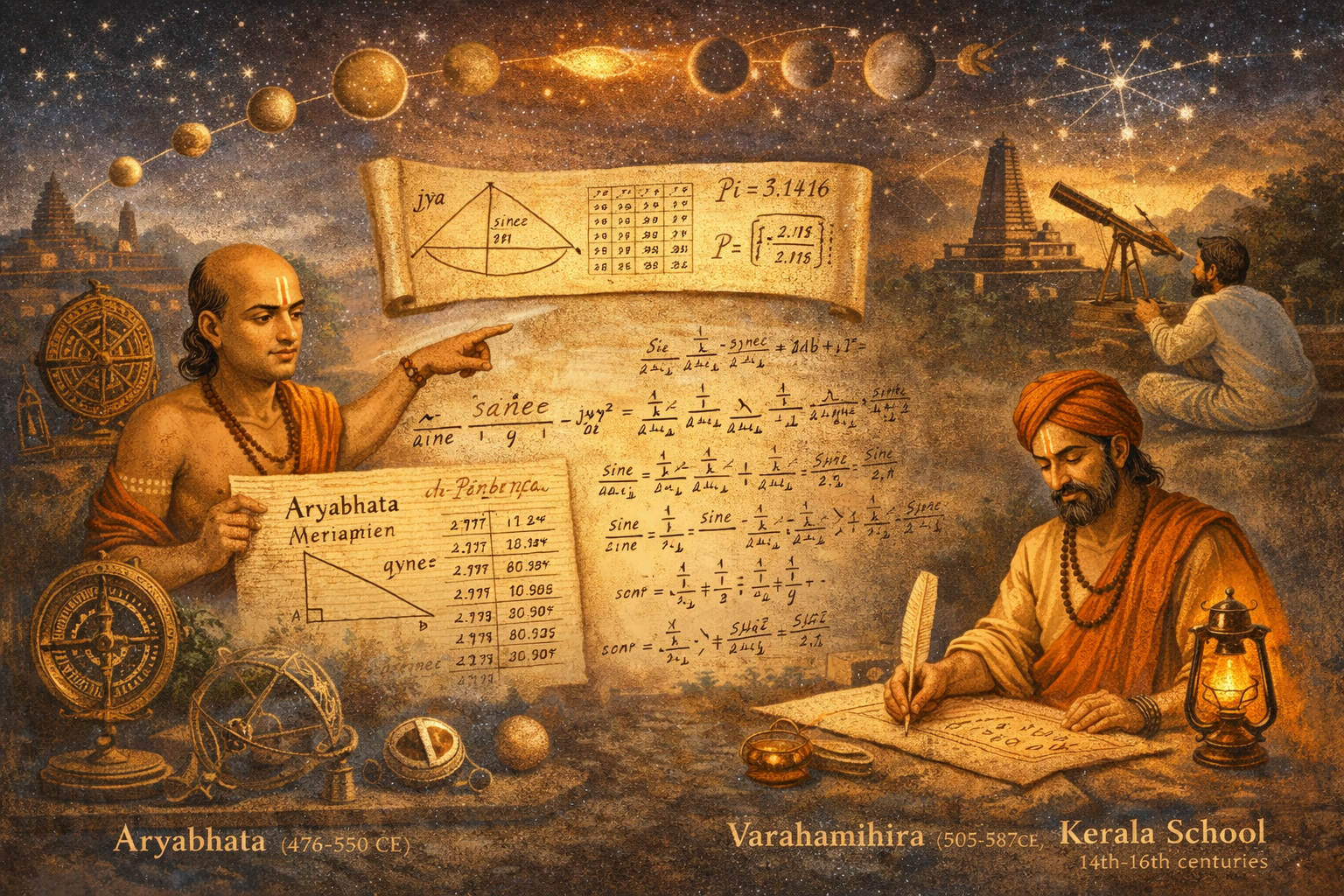
Trigonometry, another vital branch of mathematics, reached a high level of sophistication in ancient India, primarily due to its application in astronomy. The pioneering mathematician Aryabhata introduced the concept of sine, referred to as “jya,” and developed accurate trigonometric tables that enabled precise astronomical calculations. His work laid the groundwork for later developments in trigonometry, both in India and abroad. Aryabhata also provided an approximation of the value of pi that was remarkably accurate for its time and proposed that the Earth rotates on its axis, challenging prevailing cosmological beliefs. These contributions highlight the deep interconnection between mathematics and astronomy in Indian thought, where the study of numbers was seen as a means to understand celestial phenomena.
The tradition of integrating mathematics with astronomy continued with scholars like Varahamihira, whose works combined observational data with mathematical models to predict planetary movements and eclipses. This synthesis of empirical observation and theoretical reasoning exemplifies the scientific spirit of Indian mathematics, which sought to harmonize practical knowledge with abstract principles. Mathematical astronomy in India was not merely speculative but highly precise, enabling accurate calendars and timekeeping systems that were essential for both religious and agricultural activities.
A particularly remarkable chapter in the history of Indian mathematics is the emergence of the Kerala School between the 14th and 16th centuries. This group of scholars, including the great mathematician Madhava of Sangamagrama, made pioneering contributions that anticipated many ideas of modern calculus. Madhava and his successors developed infinite series expansions for trigonometric functions such as sine, cosine, and arctangent, centuries before similar discoveries were made in Europe. Their work on limits, convergence, and approximations represents a significant leap in mathematical thinking, demonstrating that the foundations of calculus were being explored in India long before the time of Newton and Leibniz. Although these contributions remained relatively unknown outside India for many centuries, they stand today as a testament to the originality and depth of Indian mathematical innovation
The transmission of Indian mathematical knowledge to other parts of the world played a crucial role in shaping global intellectual history. Through trade and scholarly exchanges, Indian numerals and mathematical concepts were adopted by the Islamic world, where they were further developed and disseminated. From there, they entered Europe, revolutionizing mathematics during the Renaissance. The so-called “Arabic numerals” used today are, in fact, of Indian origin, reflecting the far-reaching impact of Indian mathematics on global civilisation.
Beyond its technical achievements, Indian mathematics is also notable for its philosophical underpinnings. The concept of zero, for instance, is deeply connected to Indian philosophical ideas about emptiness and infinity, particularly in Hindu and Buddhist thought. Mathematics was not seen merely as a tool for calculation but as a means of exploring fundamental truths about existence and the universe. This holistic approach gave Indian mathematics a distinctive character, blending logic, intuition, and spirituality in a way that continues to inspire scholars today.
In conclusion, the history of Indian mathematics is a story of extraordinary creativity, innovation, and influence. From the urban planning of the Indus Valley to the abstract theories of the Kerala School, Indian mathematicians have made contributions that have shaped the course of human knowledge. Their discoveries in number systems, algebra, geometry, trigonometry, and calculus have become integral to modern science and technology. More importantly, the spirit of inquiry and the pursuit of knowledge that defined Indian mathematics continue to serve as a powerful reminder of humanity’s enduring quest to understand the world.