


The Story of Buddhism in China: Origins, Spread, and Cultural Impact
Buddhism is one of the most influential spiritual traditions in Chinese history, shaping the country’s philosophy, culture, art, and social values for nearly two thousand years. Although Buddhism originated in India, it found fertile ground in China, where it gradually blended with local traditions and became a major religious and cultural force. The journey of Buddhism into China is a fascinating story of trade, cultural exchange, and spiritual transformation.
Buddhism was first introduced to China during the Han Dynasty, around the 1st century CE. The spread of Buddhism is closely linked to the famous Silk Road, an ancient network of trade routes that connected China with Central Asia, India, and the Middle East. Merchants, travelers, and monks carried not only goods such as silk and spices but also ideas, beliefs, and religious teachings. Among these travelers were Buddhist monks who brought sacred texts, statues, and teachings of the Buddha into Chinese territory.
One of the most well-known stories about the arrival of Buddhism in China involves Emperor Ming of Han. According to historical tradition, the emperor had a dream of a golden figure flying above his palace. Curious about the meaning of this vision, he sent envoys to India to learn more about Buddhism. These envoys returned with Buddhist scriptures and two monks, who are believed to have helped establish the first Buddhist temple in China, the White Horse Temple in Luoyang. This temple is often considered the birthplace of Buddhism in China.

White Horse Temple in Luoyang
As Buddhism entered China, it did not spread overnight. In the early years, the teachings were difficult for many Chinese people to understand because they were written in foreign languages such as Sanskrit. However, over time, dedicated scholars and monks translated Buddhist texts into Chinese, making the teachings more accessible. These translations played a crucial role in the growth of Buddhism and allowed Chinese thinkers to interpret Buddhist philosophy in ways that connected with local traditions like Confucianism and Taoism.
The spread of Buddhism accelerated during periods of political instability, especially between the 3rd and 6th centuries. During times of war and social unrest, many people turned to Buddhism for comfort, hope, and guidance. Buddhist monasteries became centers of learning, charity, and community support. Monks and nuns provided education, medical care, and spiritual counseling, which helped the religion gain widespread acceptance among ordinary people.
By the time of the Tang Dynasty (618–907 CE), Buddhism had become deeply rooted in Chinese society. This period is often considered the golden age of Buddhism in China. Grand temples and statues were built, Buddhist art flourished, and monks traveled abroad to study sacred texts. One of the most famous Chinese monks of this era was Xuanzang, who journeyed to India to collect authentic Buddhist scriptures and later returned to China to translate them. His travels became legendary and inspired one of China’s most famous literary works, Journey to the West.
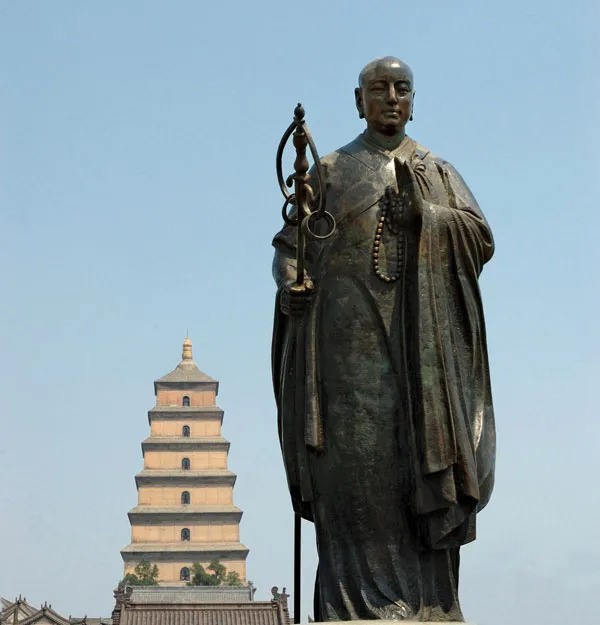
Chinese monk Xuanzang
Over the centuries, several unique schools of Buddhism developed in China. Among the most influential were Chan Buddhism (known as Zen in Japan), which emphasized meditation and direct experience of enlightenment, and Pure Land Buddhism, which focused on devotion and faith in the Buddha Amitabha. These schools made Buddhism more practical and accessible to ordinary people, helping it spread across all levels of society.
Buddhism also had a profound impact on Chinese culture. It influenced architecture through the construction of pagodas and temples, inspired beautiful paintings and sculptures, and introduced new ideas about compassion, karma, and the cycle of life and rebirth. Festivals, rituals, and moral teachings rooted in Buddhism became part of everyday life for millions of Chinese people

Buddhism in China
Today, Buddhism remains an important spiritual tradition in China, even after periods of decline and revival throughout history. Temples continue to attract worshippers and tourists, and Buddhist values such as mindfulness, compassion, and respect for life continue to shape Chinese society. The story of Buddhism in China is not only about religion but also about cultural exchange, resilience, and the enduring search for wisdom and peace.
Sanghamitra Gautam, Manipur, India